


Executive Summary
In the United States, K-12 school finance is largely controlled by the states. Good school finance systems compensate for factors states cannot control (e.g., student poverty, labor costs) using levers that they can control (e.g., driving funding to students who need it most). We have devised a framework that evaluates states based largely on how well they accomplish this balance. We assess each state’s funding while accounting directly for the students and communities served by its public schools.
These funding systems carry enormous implications for public school students. Decades of empirical research has confirmed that investing in K-12 education improves student outcomes, and funding cuts hurt those outcomes. In other words, money matters in education, and it matters a lot.
Yet how much a given district or state spends on its schools, by itself, is a rather blunt measure of how well those schools are funded. For example, high-poverty districts require more resources to achieve a given learning outcome goal—e.g., a particular average score on a standardized test—than do more affluent districts. Put differently, education costs vary depending on student populations, labor markets, and other factors. That is a fundamental principle of school finance. Simply comparing how much states or districts spend ignores this enormous variation in how much they must spend to meet their students’ needs.
State School Finance Profiles
Profiles of the K-12 school finance systems of all 50 states and D.C.
Section title
Our approach, then, is to compare states and districts in terms of not only how much they spend, but also whether that funding is adequate for students from all backgrounds to achieve common outcome goals.
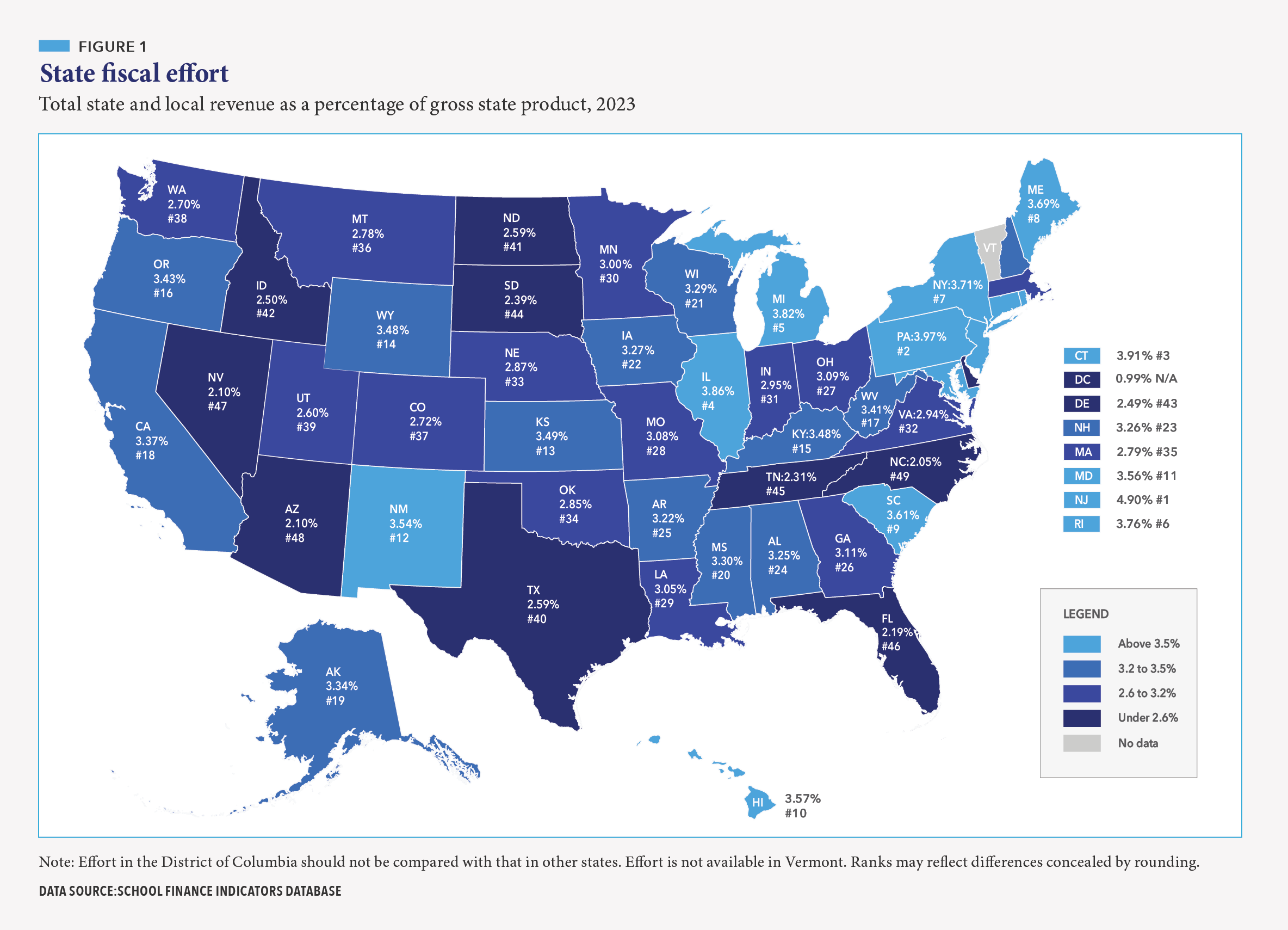
Accordingly, we use a national cost model to calculate adequate funding levels for the vast majority of the nation’s public school districts. We then use these estimates to evaluate each state—relative to other states or groups of states—based on the overall adequacy of funding across all its districts (statewide adequacy) as well as the degree to which its high-poverty districts are more or less adequately funded than its affluent districts (equal opportunity). Finally, because states vary in their ability to raise revenue (e.g., some states have larger economies than others), we also assess whether states are leveraging their capacity to fund schools by measuring total state and local revenue as a percentage of states’ economies (fiscal effort).
These three “core indicators”—effort, statewide adequacy, and equal opportunity—offer a foundational overview of whether states’ systems are accomplishing their primary goal of providing adequate and equitable funding for all students. In this report, as well as the one-page state profiles that accompany the report, we present results on these three measures for each state.
In this eighth edition of our annual report, we evaluate the K-12 school finance systems of all 50 states and the District of Columbia. Due to the lag in the publication of federal data, the latest year of results we present is for the 2022-23 school year.
Selected national findings
There are 42 states (including the District of Columbia) that devote a smaller share of their economies to their K-12 schools than they did before the 2007-09 recession. This seems to be a permanent disinvestment in public education.
Had states invested at least the same share of their economies between 2016-2023 as each did in 2006, they would have had $575 billion more for their schools, which is roughly 10 percent of total state and local school revenue during those eight years.
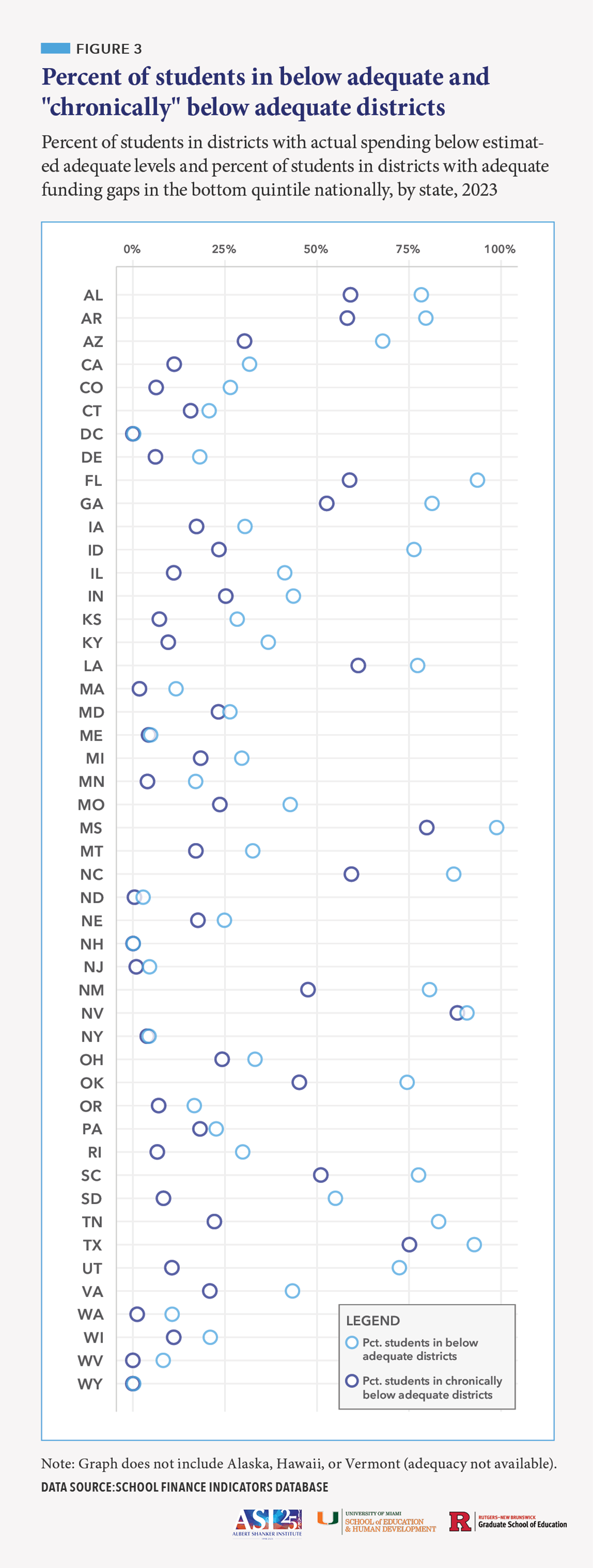
There are 10 states in which at least half of students are in districts that we identify as “chronically underfunded” districts—the 20 percent of districts with the most inadequate funding in the nation.
These states (Alabama, Arkansas, Florida, Georgia, Louisiana, Mississippi, Nevada, North Carolina, South Carolina, and Texas) serve 65 percent of the nation’s chronically underfunded students, but only 32 percent of all students.
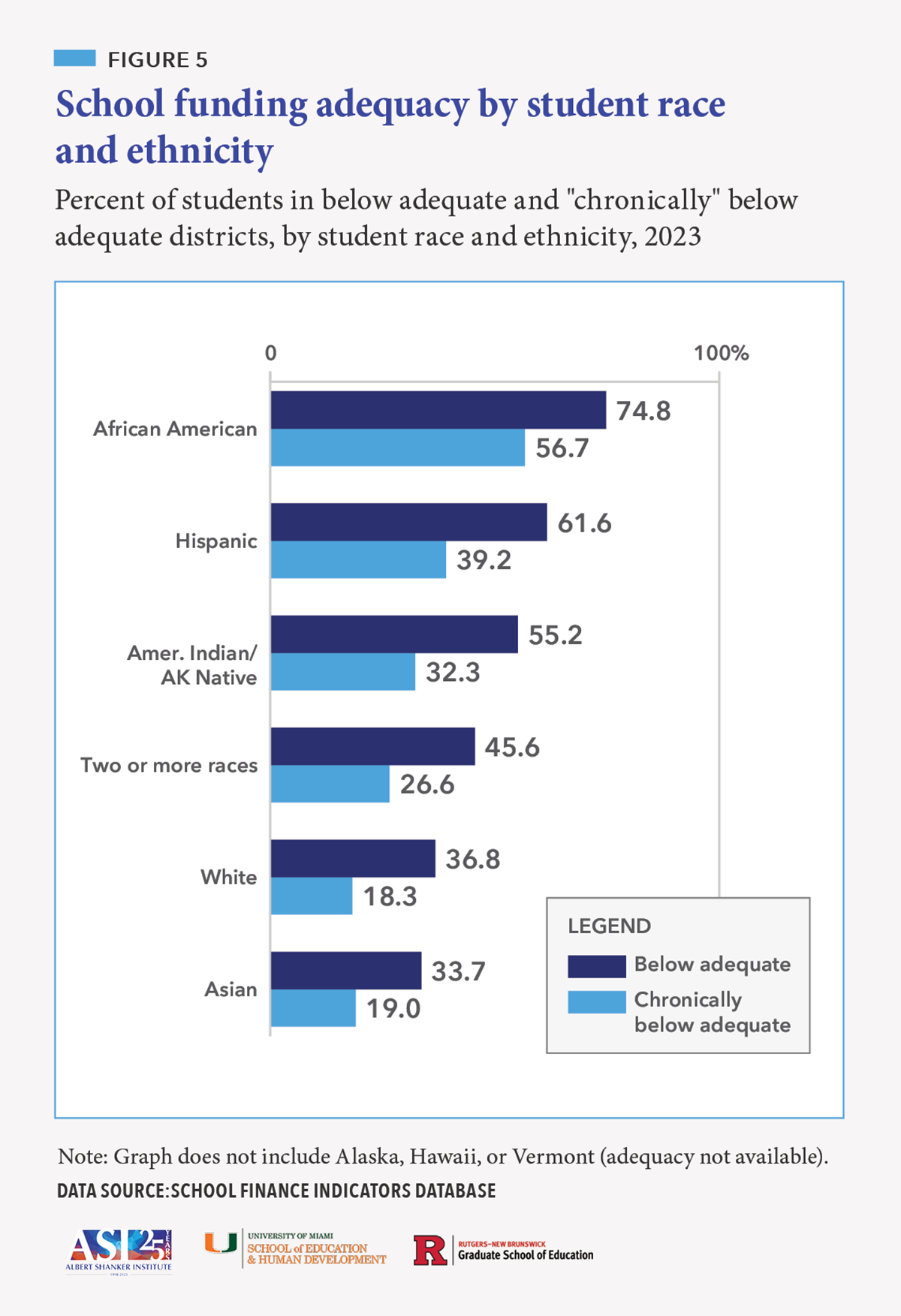
African American students are twice as likely as white students to be in districts with funding below estimated adequate levels, and three times more likely to be in chronically underfunded districts. The discrepancies between Hispanic and white students, as well as those between Native American and white students, are also substantial.
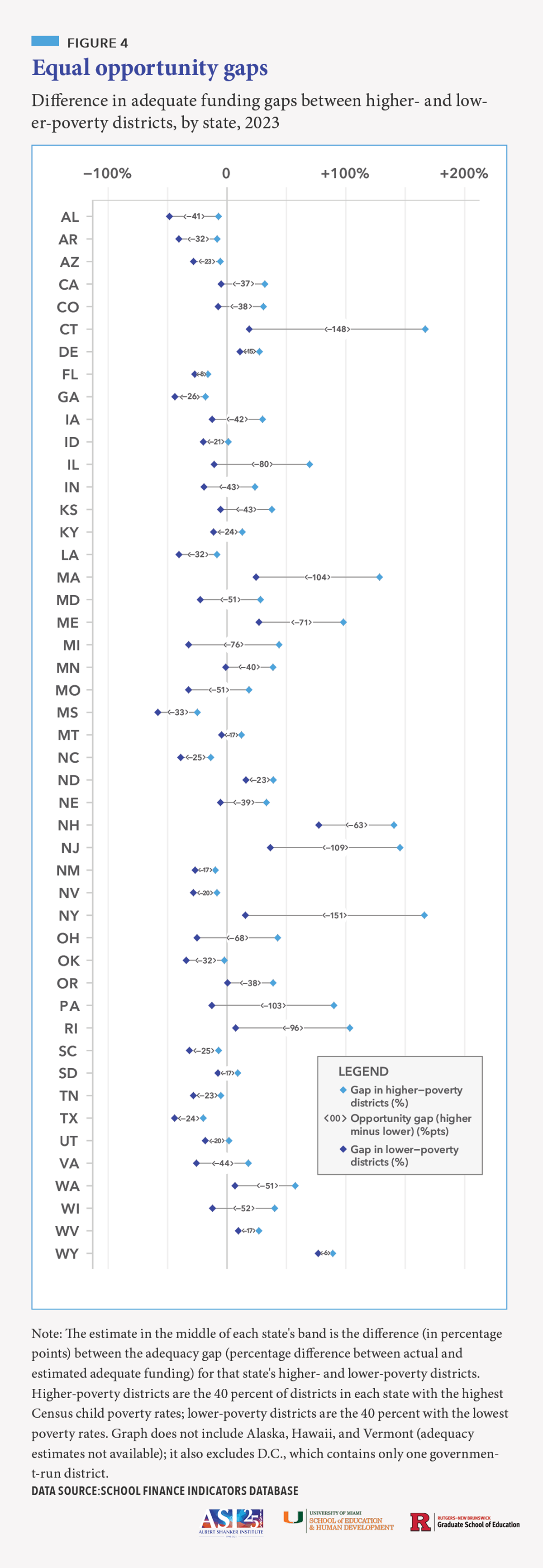
Educational opportunity is unequal in every state. The size of the gaps varies, but in every single state, higher-poverty districts are funded less adequately than lower-poverty districts. This effectively means that students in the latter (more affluent) districts are funded to achieve higher outcomes than their peers in the former (higher-poverty) districts.
Policy recommendations
Based on the results of this report, we conclude with a set of basic, research-backed principles that should guide the design and improvement of all states’ systems.
These policy recommendations include:
1. Better targeting of funding
If the amount of funding each district needs for its students to succeed is not determined rigorously by states, resources may appear adequate and equitable when they are not (and policymakers may not even realize it). All states should routinely conduct studies to ensure that they are accounting for differences in the needs of the students served by each of their school districts.
2. Increase funding to meet student needs where such funding is inadequate
The point here is for states to ensure that funding is commensurate with costs/need. In some states, adequate and equitable funding might require only a relatively moderate increase in total funding (particularly state aid) along with better targeting. In other states, particularly those in which funding is inadequate and effort is low, larger increases are needed, and may include both local and state revenue.
3. Enhance federal monitoring of school funding adequacy, equity, and efficiency
We propose that the U.S. Department of Education establish a national effort to analyze the adequacy and equity of states’ systems and provide guidance to states as to how they might improve the performance of those systems.
Our findings as a whole highlight the enormous heterogeneity of school funding, both within and among states. Such diversity is no accident. So long as school finance is primarily in the hands of states, the structure and performance of systems is likely to vary substantially between those states.
This heterogeneity has allowed researchers to study how different systems produce different outcomes and, as a result, we generally know what a good system looks like. Our framework for evaluating states is based on these principles. It is our hope that the data presented in this report and accompanying resources will inform school finance debates in the U.S. and help to guide legislators toward improving their states’ systems.