


About the Project
Over the past decade, there has been emerging political consensus regarding state school finance systems, money, and schools, supported by a growing body of high-quality empirical research regarding the importance of equitable and adequate financing for providing high quality schooling to all children.
There is, of course, serious and often contentious debate about how education funding should be spent, but virtually all potentially effective policies and approaches require investment, often substantial investment. The idea that “money doesn’t matter” is no longer defensible.
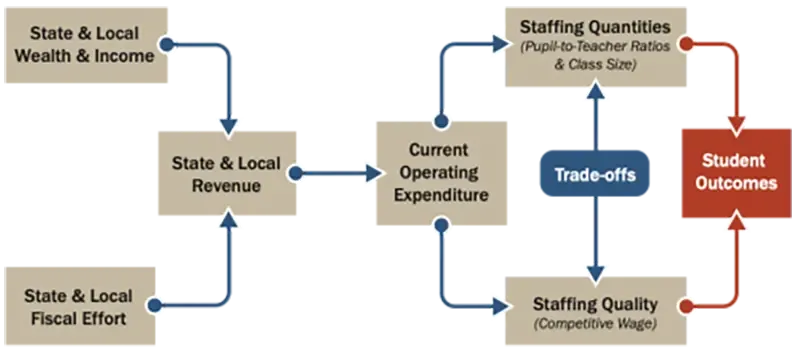
However, school finance systems, and their measurement, are highly complex, and often difficult to understand for policymakers, parents, and the general public. Acting on the empirical and political consensus about the importance of school funding therefore requires data and measures that are accessible and widely accepted as credible.
This need is the impetus for the School Finance Indicators Database, a collection of sophisticated school finance measures that can be used to assess the adequacy and fairness of state and district revenue, spending, and resource allocation, and to compare these measures between states and over time. The database is designed for use not only by researchers, but also by parents, policymakers, journalists, and the general public.
In building and presenting this system, we rely on the following core principles:
- Proper funding is a necessary condition for educational success: Competitive educational outcomes require adequate resources, and improving educational outcomes requires additional resources.
- The cost of providing a given level of educational quality varies by context: Equal educational opportunity requires progressive distribution of resources, targeted at students and schools that need them most.
- The adequacy and fairness of education funding are largely a result of legislative policy choices: Good school finance policy can improve student outcomes, whereas bad policy can hinder those outcomes.
The primary products of the system are the State Indicators Database, a collection of 125 state-by-state school finance measures, most of which are available for all years between 1993 and 2022, and the District Cost Database, a dataset of spending adequacy in over 12,000 K-12 public school districts. Both of these datasets are updated annually and freely available to the public.
In addition to an annual report presenting findings from key indicators from the state database and individual profiles summarizing each state’s finance system, we also publish regular research briefs and data visualizations examining different measures in the system. It is our hope and intention that our data, and analyses based on these data, will help to improve school finance debates and policymaking in the U.S.
This project has been supported in the past by grants from the W.T. Grant Foundation and the Bill & Melinda Gates Foundation.
Project researchers
Bruce Baker
is a Professor and chair of the Department of Teaching and Learning at the University of Miami. His research focuses on state school finance systems, cost analysis in K12 and Higher Education, teacher and administrator labor markets, and charter school policy. He is author of Educational Inequality and School Finance: Why Money Matters for America’s Students from Harvard Education Press. He has consulted with state legislatures and departments of education in numerous states, including most recently in Maryland and Vermont and has been engaged as an expert witness in litigation over the equity and adequacy of school funding in Kansas, Connecticut, New York and several other states. Since 2009, he has been involved in the production of a national report on school funding indicators which won the 2013 American Educational Research Association’s Division L Policy Report award. His recent work involves developing methods for better understanding and estimating the full costs of providing free community college.
Matthew Di Carlo
is a senior fellow at the Albert Shanker Institute in Washington, D.C. His current research focuses on education policy, including school finance, school segregation, testing and accountability, and teacher compensation. His other projects include research on cross-national political attitudes, work and occupations, and social stratification and inequality. Matt has a Ph.D. in sociology from Cornell University.
Ajay Srikanth
is a researcher at the American Institutes for Research. He received his Ph.D. from Rutgers University in 2022.
Mark Weber
is the Special Analyst for Education Policy with the New Jersey Policy Perspective and a lecturer at Rutgers University’s Graduate School of Education, where he recently earned his PhD. Weber also works as a music teacher in Warren, NJ. His policy work includes many peer-reviewed papers and policy briefs, concentrating on charter schools, school finance, and teacher quality. Weber’s blog, Jersey Jazzman, is read nationally, and his writings on education policy and teaching have appeared in The Washington Post, Education Week, and The PBS News Hour, among other outlets.
The project researchers would also like to acknowledge the ongoing or past contributions of Bilan Jama, Emilee O’Brien, Kayla Reist, Lauren Schneider, and Vicki Thomas.